Combining Organic and Paid Data in One Client Report
Your client isn't running separate businesses for organic search and paid advertising. They're running one business with multiple marketing channels. So why are you sending them separate reports for each channel?
Your client isn't running separate businesses for organic search and paid advertising. They're running one business with multiple marketing channels. So why are you sending them separate reports for each channel?
Integrated reporting that combines organic and paid performance data provides insights that isolated reports simply can't deliver. It shows the complete customer journey, reveals channel interactions, and demonstrates true marketing ROI in ways that resonate with business owners.
Why Unified Reporting Matters
When you report on organic and paid search separately, you miss critical insights about how these channels work together. You can't see whether paid campaigns are compensating for organic shortfalls, whether organic growth is reducing paid spend needs, or whether the channels are competing for the same keywords inefficiently.
Clients benefit from unified reporting because it gives them a complete picture of their search presence. They can make informed budget allocation decisions, understand total cost per acquisition across channels, and see how their entire search strategy performs rather than isolated pieces.
For agencies, unified reporting positions you as strategic partners rather than channel-specific vendors. You're not just "the SEO agency" or "the PPC agency"—you're the team managing their complete search presence.
The Metrics That Matter for Integrated Reporting
Certain metrics become much more valuable when viewed across both organic and paid channels. These integrated metrics reveal insights that channel-specific data conceals.
Total Search Traffic: This combines organic and paid clicks to show complete search presence. This metric reveals whether overall search traffic is growing regardless of channel mix. If total search traffic is stable but the organic-to-paid ratio is shifting, that tells a different story than if one channel grew while the other declined.
Cost Per Click (CPC): When compared across channels, it can show efficiency differences. Organic traffic is free at the point of acquisition but requires ongoing investment in SEO. Paid traffic has explicit costs but can be turned on or off instantly. Comparing these costs helps justify budget allocation decisions.
Conversion Rate: Viewed across channels, this reveals whether traffic quality differs between organic and paid sources. If paid traffic converts at 4% but organic traffic converts at 6%, that's critical information for budget decisions. Lower-converting paid traffic might still be worthwhile if volume compensates, or it might indicate targeting problems.
Total Cost Per Acquisition This is perhaps the most important integrated metric. It shows how much you're spending across all channels to acquire a customer. This number drives business decisions more effectively than channel-specific metrics because it reflects actual business economics.
Identifying Keyword Overlap and Opportunities
When you combine organic and paid data, keyword overlap becomes visible. These are search terms where your client appears in both paid ads and organic results—and they're paying for traffic they might be able to capture organically.
Some keyword overlap is strategic. For branded terms, appearing in both organic and paid results dominates the search page and maximizes visibility. For high-value commercial keywords, dual presence might be worth the cost because it ensures visibility regardless of organic ranking fluctuations.
But unintentional overlap is wasteful. If you're ranking in position 2-3 organically for a keyword but still running paid ads for it, you're paying for traffic you'd likely capture anyway. Identifying these situations lets you reallocate budget to keywords with less organic coverage.
The opposite scenario is equally valuable. Keywords with strong paid performance but weak organic presence represent opportunities. These are proven valuable search terms where improving organic rankings could reduce paid spend dependency.
Understanding the Organic-Paid Interaction
Organic and paid search don't operate in isolation. They interact in ways that affect performance, and understanding these interactions improves your strategic recommendations.
Some studies suggest that appearing in both organic and paid results increases total clicks beyond what either channel achieves alone. The dual presence establishes credibility and increases visibility, potentially lifting overall click-through rates.
Paid campaigns can provide quick data on keyword value while you build organic rankings. If a keyword converts well in paid search, that validates investing in organic content targeting the same term. Conversely, poor paid performance might suggest reconsidering organic targeting priorities.
Brand protection is another interaction to consider. When competitors bid on your client's brand terms, running defensive paid campaigns prevents traffic loss even with strong organic rankings. The cost is often lower than the value of protecting market share.
Presenting Unified Data Effectively
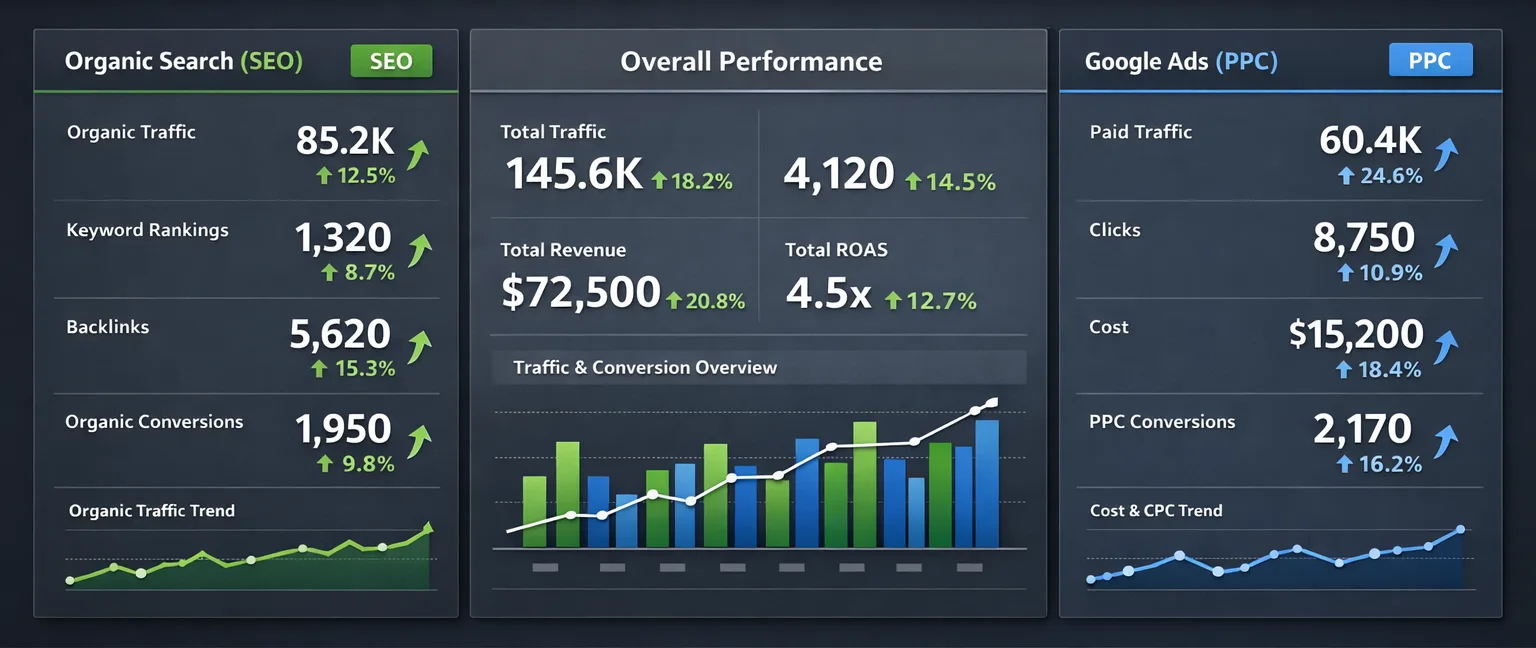
Combining organic and paid data in reports requires thoughtful presentation to avoid confusion. Clear visual separation with unified totals works well.
Use grouped bar charts to show organic and paid metrics side by side for direct comparison. For example, a chart showing monthly organic clicks next to paid clicks reveals traffic mix at a glance. Include a total line showing combined performance.
When reporting costs, present organic and paid separately with clear context. Organic costs include your retainer or SEO expenses. Paid costs include ad spend plus any management fees. Total marketing costs combined with total conversions yields true cost per acquisition.
Color coding helps readers distinguish channels quickly. Use consistent colors throughout your report—perhaps blue for organic data and orange for paid data. This visual consistency makes complex data easier to interpret.
Traffic Source Analysis
Beyond just organic versus paid, analyze traffic patterns to understand the complete search picture. Look at direct traffic alongside organic and paid—spikes in direct traffic often follow strong paid campaigns as users remember the brand and return directly.
Referral traffic from organic content syndication or backlinks earned through SEO efforts should be acknowledged as organic channel benefits. These indirect effects demonstrate SEO value beyond rankings and organic clicks.
Device analysis across channels reveals important patterns. If mobile paid traffic converts poorly compared to mobile organic traffic, that might indicate landing page problems or mobile ad messaging issues rather than channel-level performance differences.
ROI Calculation Across Channels
Calculating return on investment requires combining revenue data with costs across both channels. This is where unified reporting proves its strategic value.
Start with total revenue attributed to search traffic—both organic and paid. Subtract total search marketing costs including agency fees, ad spend, and content creation expenses. The result is your net return from search marketing.
This holistic ROI number matters more to clients than channel-specific metrics because it reflects actual business performance. A client doesn't care if organic is "winning" or paid is "winning"—they care whether their total search investment is profitable.
Break this down by time period to show trends. Is ROI improving as organic gains reduce paid dependency? Is ROI stable even as channel mix shifts? These insights drive budget decisions.
Seasonal Patterns and Budget Allocation
Combining organic and paid data reveals seasonal patterns that inform budget allocation strategy. Some businesses see predictable seasonal fluctuations where paid spend should flex to compensate for organic volatility.
For example, retail clients might see organic traffic drop during high-competition shopping seasons as larger competitors dominate rankings. Increasing paid spend during these periods maintains overall traffic despite organic challenges. During slower periods, you might reduce paid spend and rely more heavily on organic traffic.
Long-term trends also become visible. If organic traffic grows steadily while paid costs remain constant, your cost per acquisition is improving even if absolute paid performance stays flat. This demonstrates SEO value in concrete financial terms.
Competitive Context
When you combine organic and paid reporting, you can provide competitive context that single-channel reports miss. You might note that competitors are increasing paid spend in response to your organic gains, or that organic ranking improvements are reducing the paid bids competitors must pay.
This competitive narrative helps clients understand market dynamics and appreciate the strategic value of balanced channel investment. Relying entirely on paid search leaves you vulnerable to competitors outbidding you. Relying entirely on organic leaves you vulnerable to algorithm updates. Balanced investment provides resilience.
Reporting on Channel-Specific Strategies
Even in unified reports, some space should be dedicated to channel-specific tactics and performance. The goal isn't to eliminate channel-specific reporting but to position it within an integrated strategic context.
Your paid search section might detail campaign structure, ad copy testing results, and bid strategy adjustments. Your organic section might cover content publishing, technical SEO improvements, and ranking changes. But both sections should reference how they support overall search performance goals.
What to Include in an Integrated Search Report
A comprehensive integrated search report should include an executive summary showing total search performance, traffic breakdown by channel with trends, cost analysis comparing organic and paid investment, conversion metrics across channels, keyword overlap analysis with strategic recommendations, ROI calculation for total search investment, and channel-specific details and tactics.
This structure provides the strategic overview clients need to make budget decisions while maintaining the tactical detail that demonstrates ongoing value.
Frequency and Timing
Integrated search reporting works well on a monthly cadence for most clients. This timeframe captures enough data to identify trends without overwhelming clients with too-frequent updates.
For clients with significant paid spend or rapidly evolving markets, supplementary weekly snapshots of paid performance between monthly comprehensive reports can be valuable. But these should be brief updates, not full reports.
Quarterly deep-dive reports that analyze longer-term trends across both channels are valuable for strategic planning. These might include year-over-year comparisons, seasonal analysis, and budget allocation recommendations for the coming quarter.
Common Integrated Reporting Challenges
Several challenges emerge when combining organic and paid data. Being aware of these helps you address them proactively.
Attribution becomes complex when users interact with both organic and paid touchpoints before converting. Standard analytics attribution models might credit only the last click, missing the role both channels played. Consider using assisted conversion data or multi-touch attribution models for more accurate insight.
Comparing metrics with different characteristics can confuse clients. Organic impressions from Search Console and paid impressions from Google Ads measure different things—organic impressions count any appearance in search results, while paid impressions count ad displays. Clarify these definitional differences when presenting data.
Budget allocation decisions can become contentious when data shows channel performance differences. Frame these discussions around total ROI and business goals rather than channel competition. Both channels serve the business, not themselves.
Streamline Your Integrated Reporting
Sonrai pulls data from Google Analytics, Search Console, and Google Ads into unified reports that show your complete search performance. See organic and paid metrics side by side with AI-generated summaries highlighting key trends.
Start your free trial and create integrated reports that demonstrate total search value.